Jump to top menu Jump to main menu Jump to content
research
Department

Internal Medicine Laboratories

We pioneer innovation in research, education and care by bringing science to the patient. We continually develop and apply new (digital) technologies within our department, and test these innovations in practice. We actively test these innovations in practice, so that scientific knowledge directly benefits our patients while improving the way we research, teach and provide care.

Welcome to the research department of Internal Medicine 


Our mission is to conduct cutting-edge research to improve both current and future patient care, as well as the health of the general population. We use three cornerstone approaches in our research:

  1. Studying rare diseases to identify general principles of disease that also pertain to common conditions with high societal burden.
  2. Focusing on translational research with a strong bedside-to-bench-and-back approach using tandems of basic scientists and clinical investigators to study mechanisms of disease.
  3. Using technological innovation, in collaboration with the Convergence partners, to address the complexities of internal diseases.

About our Department

Our research

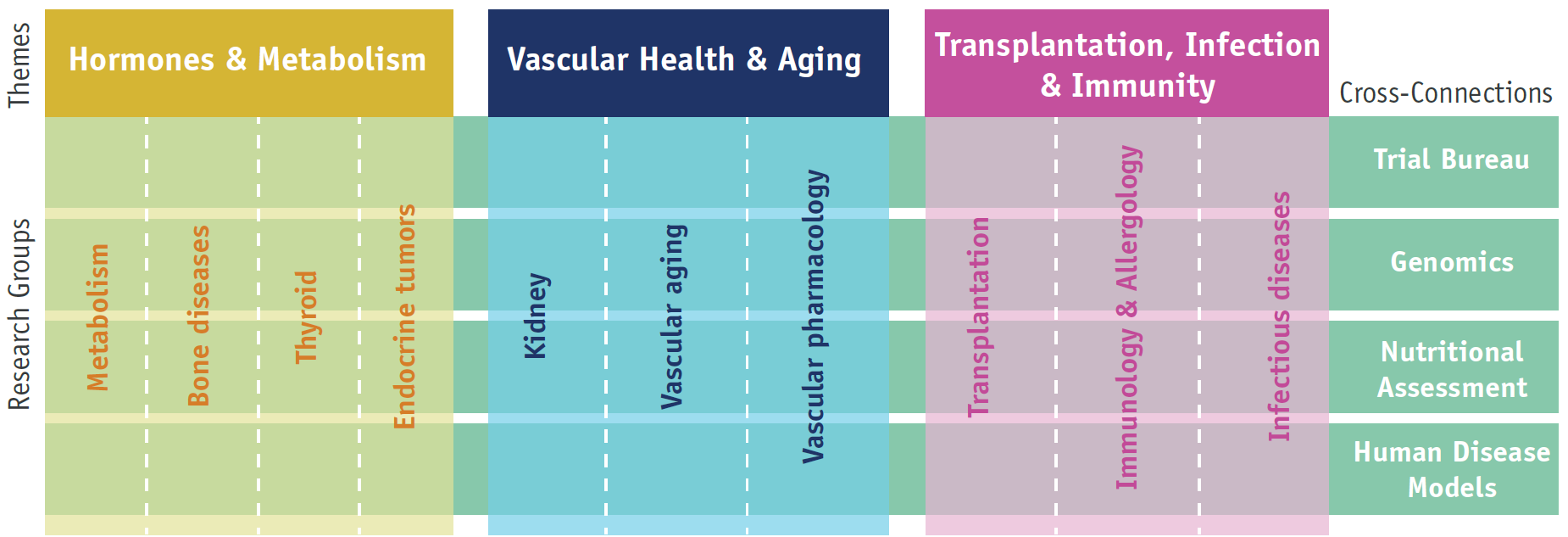
The department’s research programme is called Clinical and Experimental Medicine (CEM).

CEM focuses on three research themes:

1. Hormones and Metabolism

2. Vascular Health and Aging

3. Transplantation, Infection and Immunity

Each research theme harbours three to four research groups, amounting to a total of ten research groups that each have a laboratory.


All research groups are connected by four cross-connections in order to stimulate intradepartmental collaboration and share resources and expertise. For sustainability, each cross-connection is based on a business case and has dedicated research personnel. 

I. The Trial Bureau facilitates and supports clinical trials and utilizes revenues from industry-sponsored trials to support investigator-initiated studies. 

II. Genomics aims to extend the possibilities of genetic testing from populations to patient cohorts; the scientists who coordinate this cross-connection are also part of the Erasmus MC Genomics Core Facility.

III. Nutritional Assessment enables researchers to apply state-of-the-art technologies to assess nutritional status, including bio-impedance, muscle ultrasound and indirect calorimetry; this cross-connection benefits from the fact that all dietitians are embedded within our department. 

IV. Human Disease Models integrates in vitro and ex vivo models to study human disease, including organ-on-chip technologies and organoids.

Principal Investigators

Principle Investigators laboratories Sector Endocrinology

Principle Investigators laboratories Sector Nephrology and Transplantation

Principle Investigators Laboratories Pharmacology, Vascular and Metabolic Diseases 


Research Groups

Genetic Laboratory of Internal Medicine / Population Genomics

Our mission is to understand the genetics and genomics of complex traits and common diseases and apply the discoveries to clinical practice.

Genomics Cross Connection

We provide support to healthcare professionals and researchers within the Department of Internal Medicine in navigating the complexities of genomics. Our services range from comprehensive data analysis to the translation of findings into clinical practice, ensuring guidance at every stage. Learn how we transform genetic research into tangible clinical applications.

Laboratory for Calcium and Bone Metabolism

The overall aim of the research group is to understand the mechanisms behind skeletal disorders and discover novel therapeutic targets for the treatment of disturbances in bone and mineral homeostasis.

Metabolism and Reproduction

The Metabolism and Reproduction lab studies sex differences in metabolic dysfunction with the ultimate goal to identify new leads in the treatment of obesity and its comorbidities.

Renal tubular disorders

We study the mechanisms of renal tubular transport and the link with human disease including renal tubular disorders, hypertension, and chronic kidney disease.

Rotterdam Transplantation Laboratorium

The research performed at The Rotterdam Transplantation laboratory is translational of nature and can be dissected into two research lines being Immune Monitoring and Tissue Repair & Cell Therapy.

Thyroid laboratory

The Thyroid laboratory (part of the Erasmus MC Academic for Thyroid Diseases) investigates the role of thyroid hormone in health and disease.

Projects

Facilities

Our research laboratories are all equipped with sufficient basic laboratory equipment. We have ML-I and ML-II cell culture facilities, bio-analyzers, FACS machines, LC-MS/MS facilities and state-of-the- art equipment for genetic analysis, including high-tech advanced machines for high throughput genetic analysis. 

Collaborations

The Department of Internal Medicine actively seeks collaboration with multiple national and international research groups. 

News, events and awards

Education

BSc & MSc students

The Department of Internal Medicine is committed to providing the Erasmus MC and national and international students and colleagues excellence in teaching and up-to-date education. We currently conduct an extensive array of training activities, including the training and education of medical doctors, medical students, PhD students, postdoctoral fellows, medical specialists, Master degree students and under- graduate students in all aspects of the fields covered by the different sectors of our department. 

Any questions?

Please contact our office if you have any questions or comments.

Contact form